UX Research · Mixed Methods

When the numbers and the stories disagree

A mixed-methods study where the quantitative signal pointed one way and the qualitative story pointed the opposite — a working example of why a single method can quietly mislead a decision.

My role
Researcher (solo)
Timeline
2023 · Purdue
Org
Graduate research
Methods
Survey analysis (GSS, n=1,820) + 20 in-depth interviews
The problem

A widely-held assumption — that more education simply produces more social trust — was being treated as settled. If you only looked at the survey, you'd ship a decision on it.

Research question

Does education level predict how much people trust others — and if the numbers say yes, do people's actual experiences agree?

Outcome

Showed the quant-only conclusion was misleading: the qualitative data refuted it, demonstrating why triangulation beats a single confident metric.

Why this is a UX research story, not just a school project

Swap 'education and trust' for any product metric and a behavioral driver, and this is a problem teams hit constantly: a clean quantitative signal that points to a confident — and wrong — conclusion. I treated it as a test of method, not a sociology paper.

Working with 2021 General Social Survey data (n=1,820 after cleaning), the cross-tab was tidy: higher education, higher trust. The tempting move is to stop there. Instead I asked whether real experiences would corroborate the number — and designed the qual phase specifically to try to break the finding.

Research judgment

Why explanatory mixed-methods, in this order

Method I chose

Quant first to establish the pattern → qual interviews to explain (and stress-test) it

The survey could show whether a relationship existed but never why. I ran 20 in-depth interviews (ages 20–69), asked the same trust question as the GSS so I could compare like-for-like, then used inductive coding to find what the number hid.

Constraints I balanced: A solo researcher on a course timeline — so I prioritized depth (45-min interviews, transcribed and coded by hand) over a larger sample, and was explicit about that limit in the conclusions.

Alternatives I considered
Report the survey result alone
Why not: Fast and 'clean' — and exactly the trap. It would have shipped a confident, wrong conclusion.
Qual-only interviews
Why not: Rich, but with no baseline pattern to explain or contradict; the tension between methods is the whole insight.
A bigger survey
Why not: More precision on the same misleading signal; precision isn't the same as truth.
What we learned

What the two methods, together, revealed

01
The qualitative data refuted the quantitative conclusion
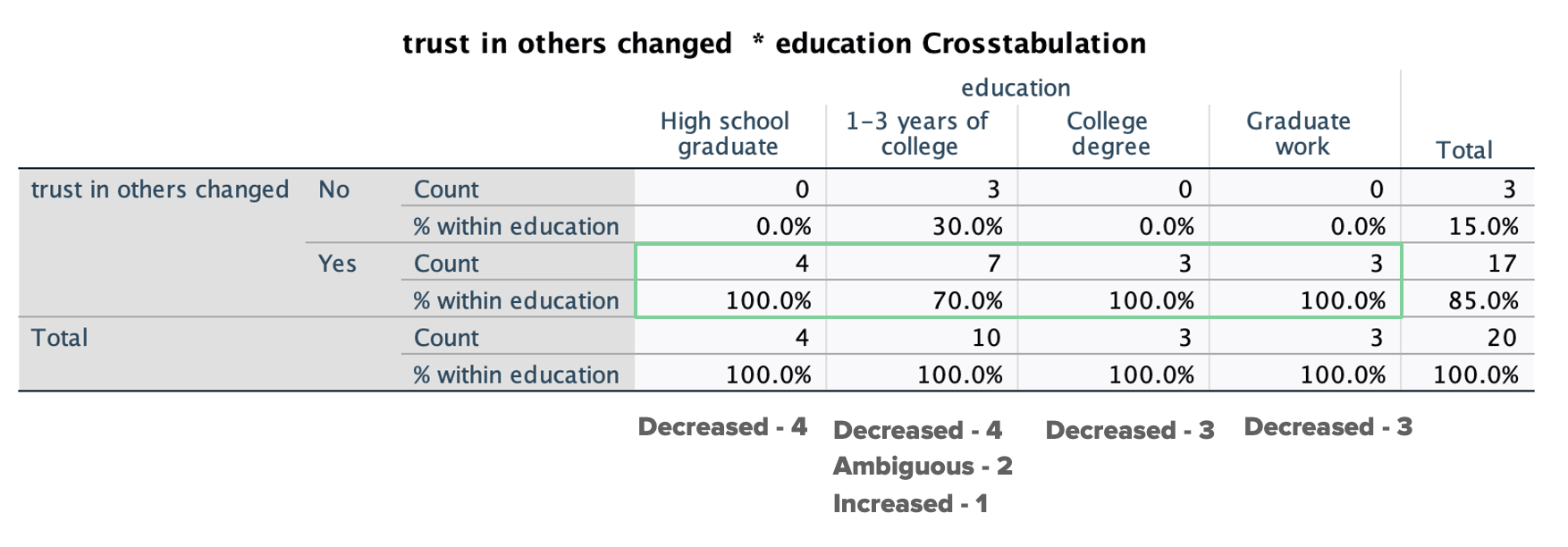
Evidence: 17 of 20 participants reported their trust had changed over time; 14 said it declined — including all high-school graduates, even those who rated their trust as high in the survey-style question.
02
Education's effect ran both directions
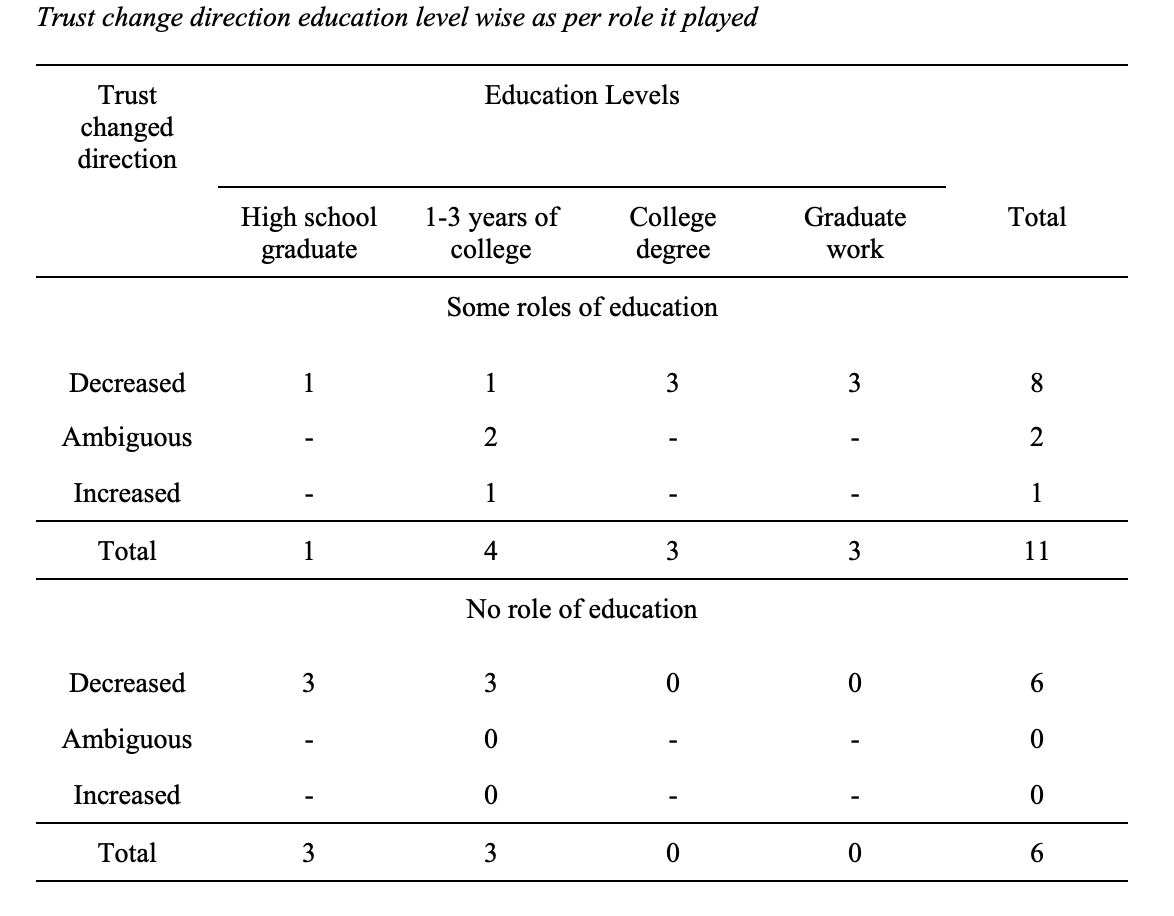
Evidence: Of the 11 who tied trust change to education, 8 became less trusting (exposure to social diversity, identity theft, betrayal), 1 more trusting, 2 ambiguous — the opposite of the tidy 'more education → more trust' line.
03
The real drivers sat outside the model
Evidence: Early-life environment, personality, and lived disadvantage outweighed the degree itself — variables the survey never captured.
From the project

From the study
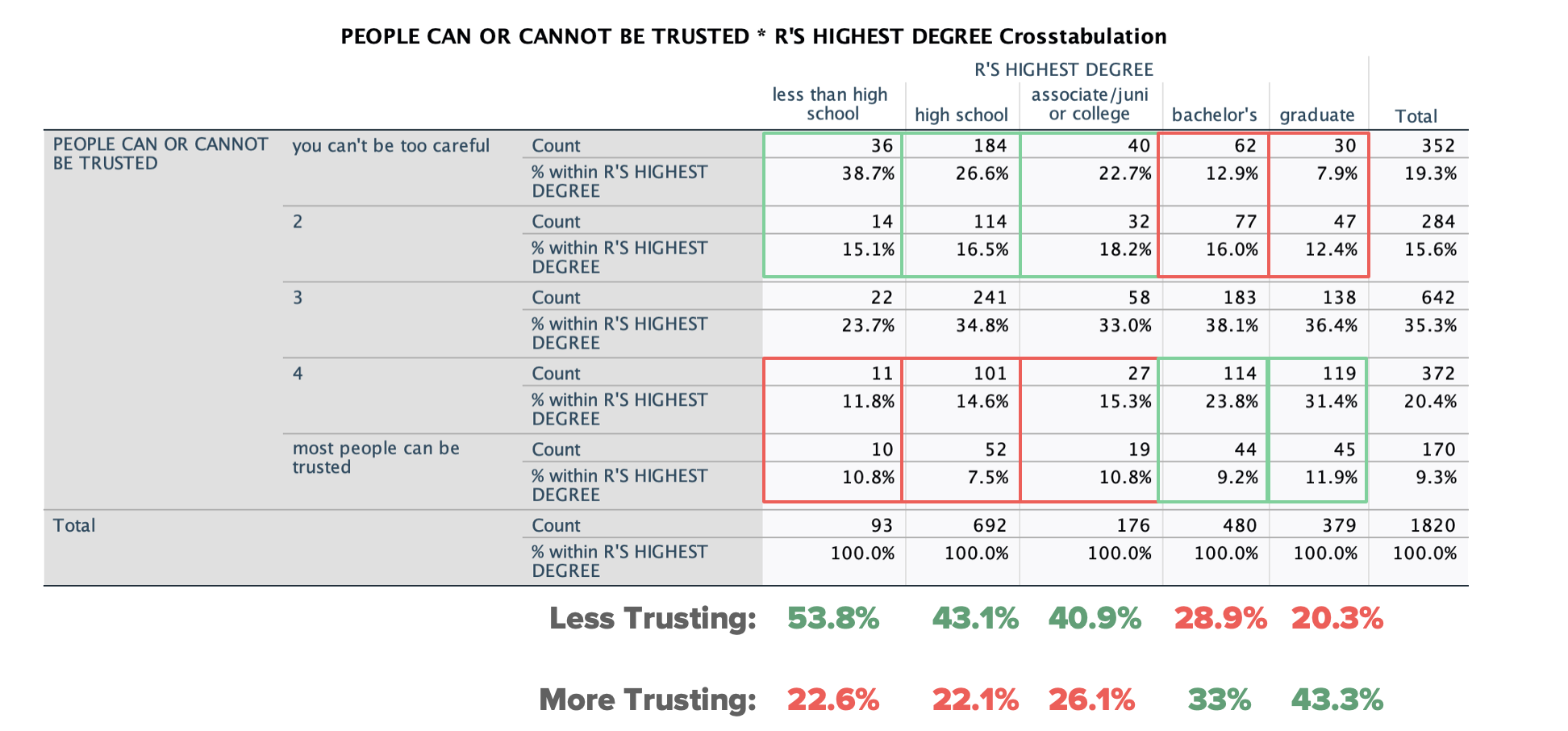
Quantitative cross-tabulation (2021 GSS, n=1,820): the tidy 'more education → more trust' signal.
Qualitative coding: 14 of 17 participants reported declining trust over time — the opposite pattern.
Interview analysis of how education actually shaped trust change.
Impact over activity

Why it matters for product work

  • A method demonstration with a transferable lesson: a single clean metric can be confidently wrong; triangulate before you decide.
  • Modeled disciplined, decision-grade synthesis: same instrument across methods, inductive coding, honest contradiction.
  • Shows I'll stress-test a flattering result rather than ship the convenient narrative.
  • Directly relevant to AI/product work where dashboards look decisive but mask the human 'why'.
If I did it again

Reflection & self-critique

What I'd change: I'd add a short follow-up survey to the interview sample to quantify the qualitative themes — closing the loop from quant→qual→quant rather than stopping at the contradiction.

What I'd keep: Designing the qual phase to actively challenge the quant finding. Setting out to break a result is the fastest way to learn whether to trust it.

Honest limit: n=20 is directional, not generalizable — and I said so. Naming the boundary is part of the rigor.