UX Research + Design

Twenty years of the stock market, told as a story

A narrative data visualization that turned five tangled economic datasets into one interactive story about market sensitivity — recognized at IEEE EuroVis and IndiaHCI.

My role
Researcher & Designer
Timeline
2015 · 4 wk
Org
NID (graduate)
Methods
Data analysis, narrative structure, prototype testing
The problem

Complex, multi-decade economic data (Sensex, GDP, FDI, rupee value, events) is near-impossible for a general audience to read — so the story it tells about market sensitivity stays locked away.

Research question

How sensitive is the Indian stock market to economic and non-economic events, and how can that be communicated so a non-expert can follow and remember it?

Outcome

An explanatory, interactive narrative that reduces cognitive load through staged storytelling — earned an honorable mention at IEEE EuroVis.

The communication problem

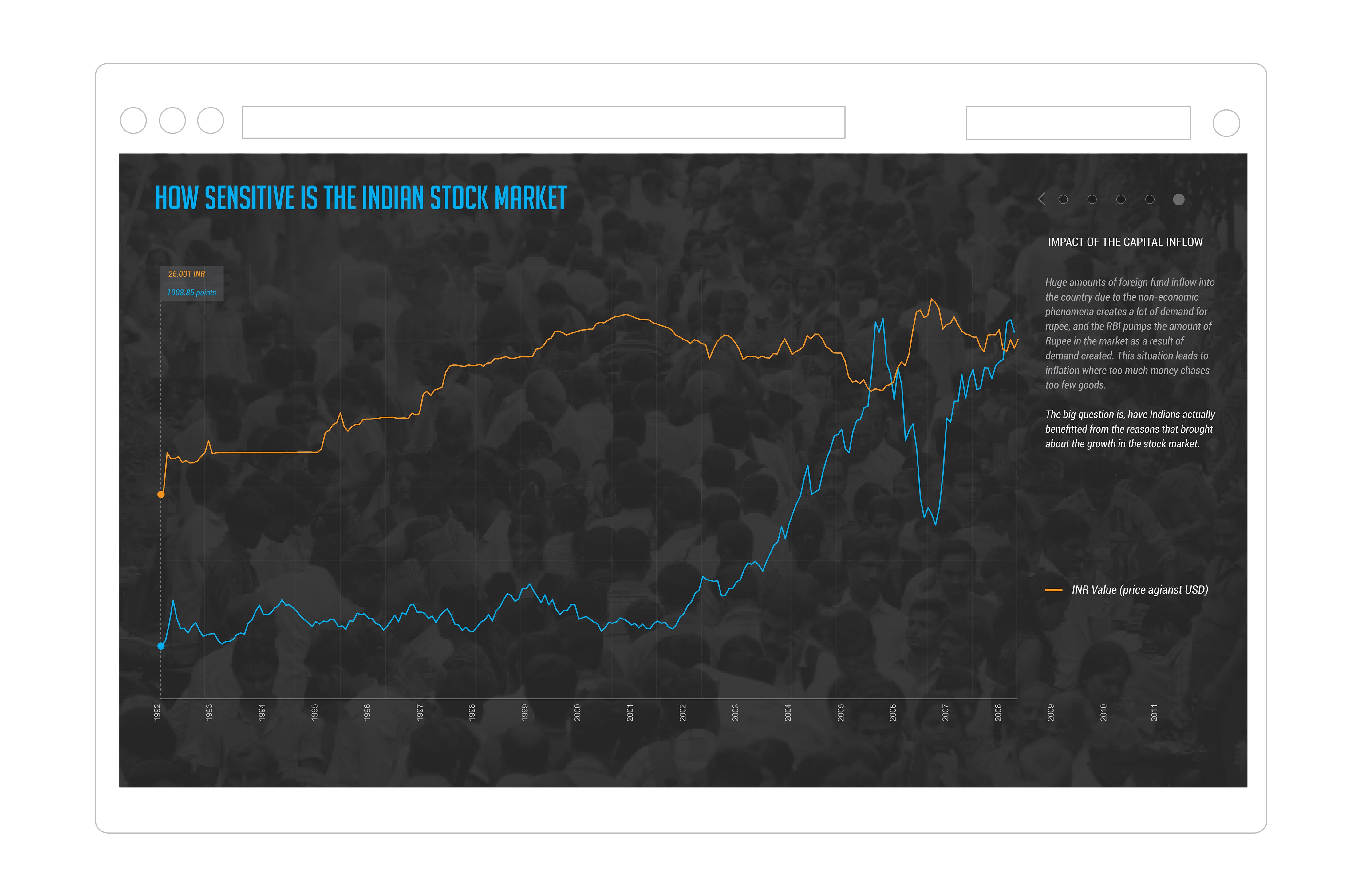
Sparked by P. Sainath's reporting on rural India, I hypothesized a relationship between national events and the country's economic index. The data existed across five sources; the challenge was making it legible and memorable, not just plotting it.

I mined and cleaned two decades of data in R and Excel, built the charts, then layered annotation, color, and a narrative arc in Illustrator and After Effects — researching news for specific dates to explain each rise and fall.

Research judgment

Why narrative + interactive structure

Method I chose

An interactive slideshow: author-driven arc with reader-driven exploration mid-narrative

A pure free-explore tool would overwhelm; a pure linear story would bore and hide nuance. The hybrid keeps a guiding arc (martini-glass style) while letting users branch into points that interest them — balancing focus and agency.

Constraints I balanced: Four weeks, solo, and a topic most people find intimidating — so I optimized ruthlessly for comprehension over completeness, showing only events that fit the pattern and saying so.

Alternatives I considered
A free-form interactive dashboard
Why not: Maximizes exploration but offers no narrative scaffolding — high cognitive load, low recall for a general audience.
A static infographic
Why not: Memorable but can't carry a multi-variable, multi-decade story or let users interrogate it.
What we learned

Key insights

01
Events and the index are negatively correlated
Evidence: Non-economic shocks — politics, conflict, disasters — consistently tracked against Sensex movement across the two-decade series.
02
Interaction can fight the story arc
Evidence: Testing surfaced the core tension: mid-narrative interaction competes with narrative focus, so affordances had to be designed to guide, not distract.
03
The data's values, not just structure, make the story
Evidence: An effective narrative depended on which real patterns existed in the numbers — design couldn't manufacture a story the data didn't hold.
From the project

The narrative visualization
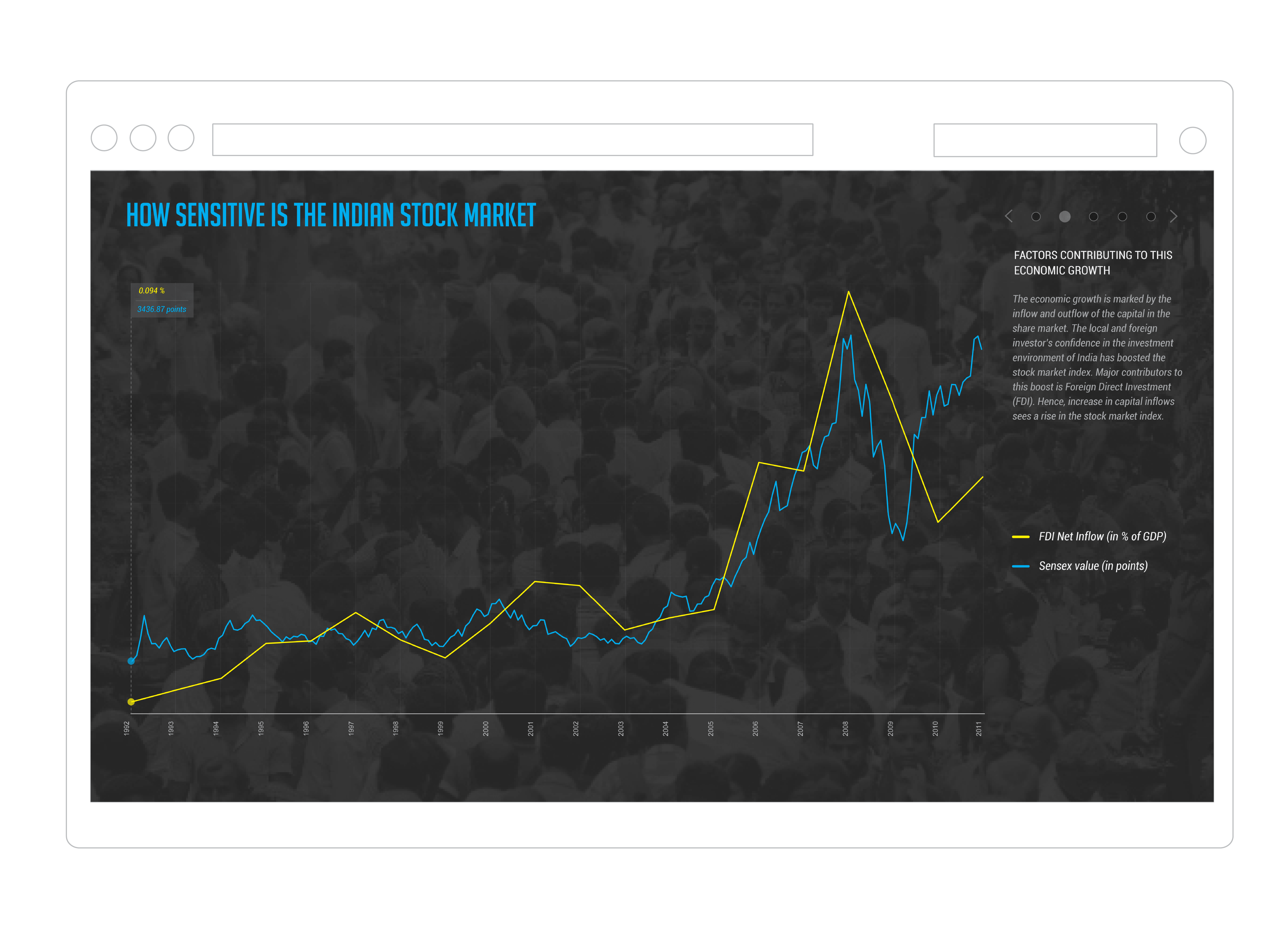
GDP growth mapped against the Sensex.
Non-economic events plotted against market movement.
The final interactive narrative.
Impact over activity

Recognition & outcome

  • Honorable mention, poster award, IEEE EuroVis (Barcelona) — in the EG digital library.
  • Published at the 8th IndiaHCI conference proceedings.
  • A reusable model for explanatory, low-cognitive-load data storytelling.
  • Ends on an open question by design — prompting the audience to keep thinking, not just consume.
If I did it again

Reflection & self-critique

What I'd change: I'd define success metrics for the story (engagement, recall, decision confidence) and test against them, rather than evaluating craft subjectively.

What I'd keep: The author-driven + reader-driven hybrid. It's the structural choice that made a hard topic both guided and explorable.

What I learned: In data storytelling, editing is the work — what you leave out is what makes the rest legible.

Watch

The complete story